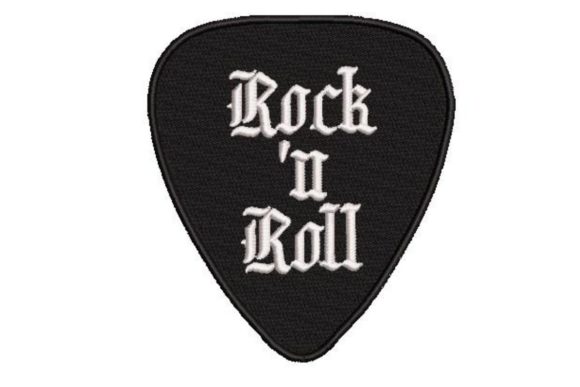
Guitar Pick Rock
First Impressions: A Playful, Confident Silhouette
When Guitar Pick Rock landed in my inbox, I paused—not because it’s flashy or overdesigned, but because it’s *immediately legible*. It’s a clean, slightly elongated guitar pick shape with subtle contouring and a confident tilt. There’s no clutter, no unnecessary flourishes—just a strong, music-infused silhouette that reads as both nostalgic and contemporary. As a designer who reviews hundreds of embroidery files a year, I appreciate how rare it is to find a design this simple yet so full of personality. It doesn’t scream “rock star”—it *nods* to one. That makes it versatile: not just for bands or guitar teachers, but for coffee shops with live music nights, indie record stores, or even a teen’s first custom sweatshirt.
A Real-World Test: Embroidering It on a Linen-Cotton Tote Bag
Last week, I used Guitar Pick Rock on a natural linen-cotton tote for a local boutique’s summer collection. The bag had a medium-weight weave—not too stiff, not too drapey—and I chose a mid-tone navy thread on off-white fabric. The result? Crisp, confident, and quietly professional. The design stitched cleanly at roughly 3.5" wide, holding its shape without distortion. No puckering. No thread breaks. What stood out most was how well the satin stitch edges held up on the textured surface—no fraying, no skipped stitches. That tells me Guitar Pick Rock has thoughtful stitch planning: balanced density, smooth transitions between fill and outline, and generous underlay where needed. It didn’t fight the fabric; it settled into it.
Where It Shines (and Where It Needs Thought)
- Custom apparel: Works beautifully on polo t-shirts (as advertised), but also adds charm to structured cotton oxfords or lightweight denim jackets—especially when placed on the chest or sleeve cuff.
- Sweatshirt embroidery: Holds up well on mid-weight fleece, especially with tear-away + cut-away stabilizer combo. Avoid placing it directly over thick seams or ribbed cuffs unless you test first.
- Embroidered patch: Clean lines and moderate detail make it ideal for a sew-on or iron-on patch. Just remember: if turning it into a finished patch, trim closely and seal edges to preserve that sharp pick shape.
- Baby embroidery & nursery decor: Gentle enough for onesies or pillow covers—but skip the satin stitch-heavy version for newborn items. Opt instead for a simplified fill-stitch variant (if included) or confirm the file offers a low-density option.
- Holiday embroidery & personalized gifts: Paired with a small “Est. 2024” or tiny musical note, it becomes a thoughtful gift for a grad heading to music school—or a dad who still keeps his old Fender in the garage.
Fabric & Fit: Know Before You Hoop
Guitar Pick Rock isn’t fussy—but it does ask for basic respect. On thin or stretchy fabric (like jersey tees or rayon blends), use a firm cut-away stabilizer and consider reducing top tension slightly. On dark fabric, test your thread contrast: light gray or cream works better than stark white for warmth and readability. And while it’s compact enough for a 4x4 hoop, don’t cram it into a 3x3 unless you’ve verified the smallest version maintains clarity—tiny points and curves can blur if scaled down aggressively.
Curved surfaces like caps require extra attention. I’d recommend using a cap frame and testing on a spare front panel first. The design’s symmetry helps—it centers easily—but avoid placing it too high on the crown where stitch distortion increases.
Design Integrity in Finished Products
This is where Guitar Pick Rock earns trust. It doesn’t look “digital” or “clip-art-y” when stitched. The proportions feel intentional—the width-to-length ratio echoes real picks, and the slight taper gives motion, not stiffness. That authenticity translates directly to perceived value: customers notice when a design feels *made*, not just placed. For Etsy sellers and small shop owners, that difference builds credibility. A customer buying a Guitar Pick Rock–embroidered apron isn’t just buying kitchen gear—they’re buying a story, a vibe, a quiet nod to creativity.
It also scales well across branding touchpoints. Use it as a subtle tag on a tea towel, then repeat it in a printable mockup for your shop listing. Pair it with handwritten font labels for craft fair tags. Its simplicity means it won’t compete with other elements—it supports them.
Practical Designer Notes Before You Stitch
- Always test Guitar Pick Rock on scrap fabric matching your final project’s weight and texture—even if you’ve used it before. Thread batch variations and machine calibration shift results.
- Review stitch density visually in your embroidery software. If it looks overly dense in the center, consider adjusting fill angle or density settings before stitching.
- Check whether the embroidery file includes multiple sizes or versions (e.g., simplified for baby items, outlined for applique). Not all music-themed designs do—but this one should earn that flexibility.
- Use black-and-white mockups to assess contrast and legibility. A design that pops on screen may vanish on charcoal fabric.
- Confirm licensing terms before selling finished products or reselling the digital embroidery file. This is non-negotiable for craft businesses and Etsy sellers.
- For commercial embroidery projects, verify compatibility with your machine’s format requirements—and double-check that “multiple embroidery file formats” includes your system’s native type (e.g., .dst, .pes, .jef).
Final Thought: A Design That Serves the Maker
Guitar Pick Rock isn’t trying to be everything. It’s a focused, well-executed machine embroidery design that does one thing very well: represent musical spirit without cliché. It fits naturally into real workflows—whether you’re stitching fifty tote bags for a festival vendor or embroidering a single personalized gift for a friend’s birthday. It respects your time, your machine, and your customer’s eye. In a category crowded with overworked motifs and pixelated riffs, Guitar Pick Rock stands out by staying simple, sincere, and stitch-ready.