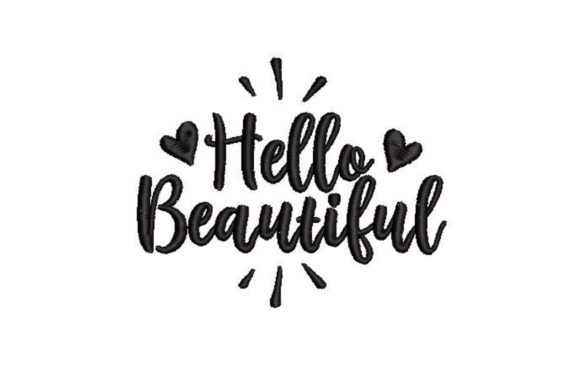
Hello Beautiful
First Impressions: Graceful, Feminine, and Ready for Real Projects
As an embroidery designer who’s stitched thousands of commercial orders—from boutique aprons to Etsy baby blankets—I opened Hello Beautiful expecting charm. What I found was something more: a quietly confident machine embroidery design with delicate balance. The lettering flows like hand-drawn calligraphy—soft curves, gentle tapering, and just enough lift in the terminals to avoid looking stiff. There’s no heavy shadowing or aggressive embellishment; instead, it leans into elegance through spacing, rhythm, and intentional negative space. It feels like a whisper—not a shout—which makes it unusually versatile for both minimalist apparel and layered nursery decor.
Fits Naturally Where Handmade Meets Heartfelt
Hello Beautiful doesn’t scream “trend.” It settles in where intention matters: on a linen kitchen towel gifted to a new mom, across the chest of a cotton sweatshirt sold at a local craft fair, or centered on a 6” hoop pillow cover styled for an Instagram shop feed. Its scale suggests intimacy—not grand statement—so it shines brightest on pieces meant to be held, worn, or kept close. I tested it as a tote bag design (front-center, 4.2” wide) and as a sweatshirt embroidery (left-chest placement), and both felt cohesive—not like a sticker slapped on, but like part of the garment’s quiet identity.
Real-World Performance Across Fabrics and Forms
Stitching Hello Beautiful on a curved cap surface required slight digitizing adjustments—mainly tightening satin stitch angles and reducing density in the lower curve—to prevent puckering. On stretchy fabric like lightweight French terry, a medium-weight cutaway stabilizer kept letter integrity intact without stiffness. For dark fabric, I swapped standard white thread for a soft ivory—less contrast, more warmth—and it elevated the handmade product’s sophistication. On textured weaves like burlap-blend tea towels, I added a light tear-away topping to smooth the surface before stitching; the fill stitch held beautifully without sinking.
Where Hello Beautiful truly earns its place is in products that endure washing: baby blankets, kitchen towels, and embroidered patches meant for denim jackets. Its stitch density feels considered—not overly tight (which risks thread breakage), not too loose (which invites fraying). No dense clusters of satin stitch trap moisture, and running stitch accents between letters add breathability. That practicality supports long-term customer trust: when buyers see clean, durable stitching after three washes, they remember your brand—not just the design.
Commercial Use Considerations for Sellers and Studios
If you’re listing Hello Beautiful as part of an Etsy collection—or bundling it into custom apparel packages—its visual tone sets expectations. It pairs naturally with neutral palettes, organic fibers, and photography that emphasizes texture and light. A printable mockup using this digital embroidery file gains authenticity when shown on matte-finish cotton rather than glossy synthetics. For boutique merchandise, it works especially well alongside complementary design assets: subtle floral borders or single-stem line art that shares its lyrical line weight.
Crucially, Hello Beautiful avoids overcomplication. There are no nested applique layers or multi-hooping sequences—making it accessible for home-based embroiderers with smaller machines. That accessibility expands your production capacity without sacrificing polish. When customers receive a personalized gift stitched with Hello Beautiful, the result reads as intentional, not automated—a distinction that lifts perceived value and encourages repeat orders.
Practical Notes Before You Stitch
- Test on scrap fabric first—especially if using textured, stretchy, or dark materials. Observe how satin stitch edges settle and whether small curves hold shape.
- Confirm hoop size compatibility. While the design scales well, verify the largest version fits comfortably within your machine’s maximum hoop dimensions before finalizing a client order.
- Review stitch density in your embroidery software. If adding it to a high-wear item (like a child’s backpack strap), consider a 5–7% reduction in fill density for flexibility and longevity.
- Use proper stabilizer: cutaway for knits and wearables, tear-away for stable wovens, and topping for napped or fuzzy surfaces.
- Inspect small details post-stitch: check terminal points and inner curves for stray thread ends or skipped stitches—especially important for finished product photography.
- Verify licensing on the Creative Fabrica product page before selling physical items. Some Beauty category embroidery files include personal-use-only terms; confirm commercial embroidery rights apply to your intended use case.
Why It Stands Out Among Embroidery File Choices
In a sea of bold, script-heavy machine embroidery designs, Hello Beautiful offers restrained confidence. It doesn’t compete with busy patterns or loud branding—it complements them. As a standalone embroidered patch, it adds quiet authority. As a tote bag design, it invites pause. As a sweatshirt embroidery, it softens streetwear edges without losing presence. Its strength lies in adaptability, not dominance.
For creative entrepreneurs building a recognizable aesthetic—whether through seasonal handmade gifts, curated boutique lines, or scalable custom apparel—Hello Beautiful functions less like decoration and more like voice. It says “thoughtful,” “considered,” and “made with care”—not because it’s complicated, but because it’s calibrated.
Final Thought: A Design That Serves the Product, Not the Other Way Around
I chose Hello Beautiful for a recent client order: a set of three linen pillow covers for a newborn’s nursery. Paired with muted sage, clay, and oat threads, it didn’t shout “baby!”—it whispered “welcome.” That’s the mark of a strong embroidery file: it enhances the object it lives on, never overwhelms it. If your work values clarity, craftsmanship, and emotional resonance over flash, Hello Beautiful earns its place in your active design library—not as filler, but as a trusted tool.