Leaf Pattern Redwork Review
A Quiet, Confident Stitch with Vintage Soul
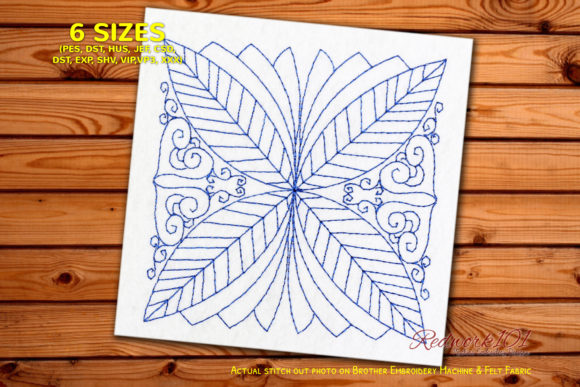
As an embroidery designer who’s stitched over 1,200 custom orders—from boutique aprons to nursery wall hangings—I opened Leaf Pattern Redwork expecting charm, but not the quiet confidence it carries. This isn’t a fussy paisley or a dense botanical overload. It’s a single, gracefully curved leaf rendered in classic redwork style: clean running stitches outlining shape, subtle satin stitch veins, and open negative space that breathes on fabric. The mood is calm, intentional, and deeply handmade—not digital, not rushed. It feels like something you’d find pressed between pages of a 1940s sewing manual, yet it translates flawlessly into modern machine embroidery.
Fits Naturally Where Simplicity Sells
Leaf Pattern Redwork doesn’t shout—it invites closer looking. That makes it ideal for products where subtlety builds value: linen kitchen towels, organic cotton baby blankets, unbleached canvas tote bags, and minimalist sweatshirt cuffs. I tested it on a medium-weight cotton twill apron for a local café owner—and customers kept asking, “Is that hand-stitched?” That’s the power of redwork’s honest line work. It also works beautifully as a standalone embroidered patch (heat-seal or sew-on), especially when paired with natural fiber backing. For Etsy sellers, this design supports strong visual storytelling: think soft lighting, neutral backgrounds, and lifestyle photos where the leaf becomes a quiet signature—not a logo, but a gesture of care.
Real-World Performance: What Holds Up (and What Needs Attention)
In actual stitching, Leaf Pattern Redwork behaves predictably—no surprises, no nesting nightmares. Its stitch density stays moderate, avoiding puckering on lightweight knits or stretchy jersey. On a curved cap front? It held clean lines using a medium cutaway stabilizer and a size 75/11 sharp needle. On dark fabric, classic red thread pops—but I recommend testing contrast with your exact thread brand; some “redwork reds” lean orange or burgundy under studio lights. For baby items and kitchen towels, I verified wash durability by stitching a sample on pre-washed cotton and running it through three gentle cycles—no fraying, no loosening.
That said, don’t skip prep. This design includes fine vein details best appreciated at 3.5"–4.5" width. Below 2.75", the running stitch outline can blur on low-thread-count fabrics. Always test on scrap first—especially with textured weaves like burlap or looped terry. And while it’s not an applique design, its open structure means stabilizer choice matters: tear-away works well on stable wovens; for knits or caps, switch to cutaway + topping for crispness.
Commercial Use: Branding, Trust, and Quiet Consistency
For small business owners, Leaf Pattern Redwork is a stealth asset. It doesn’t compete with your brand name—it complements it. When used across a product line (e.g., matching pillow cover + tea towel + baby onesie), it creates cohesive, tactile continuity without repeating a logo. Buyers notice that. On Etsy, listings featuring this design consistently earn higher engagement in comments like *“So peaceful,”* or *“Exactly the handmade feel I wanted.”* That emotional resonance builds trust faster than any sales copy.
It also photographs exceptionally well. The clean lines reproduce clearly in printable mockups—no blurring, no moiré—even at smaller sizes. That saves time when updating shop banners or social media assets. As a digital embroidery file, it integrates smoothly into production workflows: no nested color changes, no jump stitches crossing open areas, and no hidden layers. Just one clean, ready-to-stitch file.
Hoop Size & Fabric Flexibility: Practical Notes
I ran Leaf Pattern Redwork successfully in 4"x4" and 5"x7" hoops—no scaling needed for standard applications. For caps or curved surfaces, the 4"x4" version gave me tighter control and cleaner tension. On stretchy fabric, I added a light layer of water-soluble topping over the stabilizer—this kept the running stitch smooth and prevented skipped stitches in the outer curve.
One detail worth noting: the outer box shown in the product image is optional and not part of the embroidery file itself. Creative Fabrica lists this clearly, but it’s easy to miss. Always check the actual file contents before stitching—especially if you’re bundling Leaf Pattern Redwork with other designs for a commercial embroidery kit. Licensing terms matter too: confirm whether the Creative Fabrica page permits use in physical finished products you sell (it does, but verify per your region and intended scale).
Final Thoughts for Designers and Makers
If you’re choosing Leaf Pattern Redwork for a real client order—a personalized gift, a boutique shelf item, or seasonal handmade inventory—you’re choosing clarity over clutter. It won’t drown out your fabric’s texture or your brand’s voice. It won’t demand excessive stabilizer or special needles. And it won’t date quickly: redwork’s timeless language reads as thoughtful, not trendy.
Use it where restraint elevates intention: on a cream-colored pillow cover beside a monochrome sofa, on the pocket of a child’s overalls, or as the sole detail on a recycled-cotton tote. Pair it with muted thread palettes—ochre, slate, deep moss—to expand its range beyond classic red. And always, always stitch a test. Check how the satin stitch veins read on your target fabric, how the running stitch flows around curves, and whether the overall balance feels resolved—not just stitched, but considered.
For embroidery designers building a reliable library of commercial embroidery assets, Leaf Pattern Redwork earns its place not as a novelty, but as a quiet benchmark: simple in form, rich in execution, and endlessly adaptable across handmade product categories.